I was watching a HD version of Star Trek: TNG one day, and it got me curious about how image upscaling actually works as this show was aired during 90s. How do newer technologies manage to make older footage and photos look sharper and clearer, especially when you zoom in?
Eventually, I went all the way back to understanding how a camera actually works.
A camera essentially captures light through a sensor and converts that information into pixels. Millions of tiny pixels come together to form the photograph we see. But pixels have a limitation. Enlarge an image beyond a certain point, and it starts losing clarity.
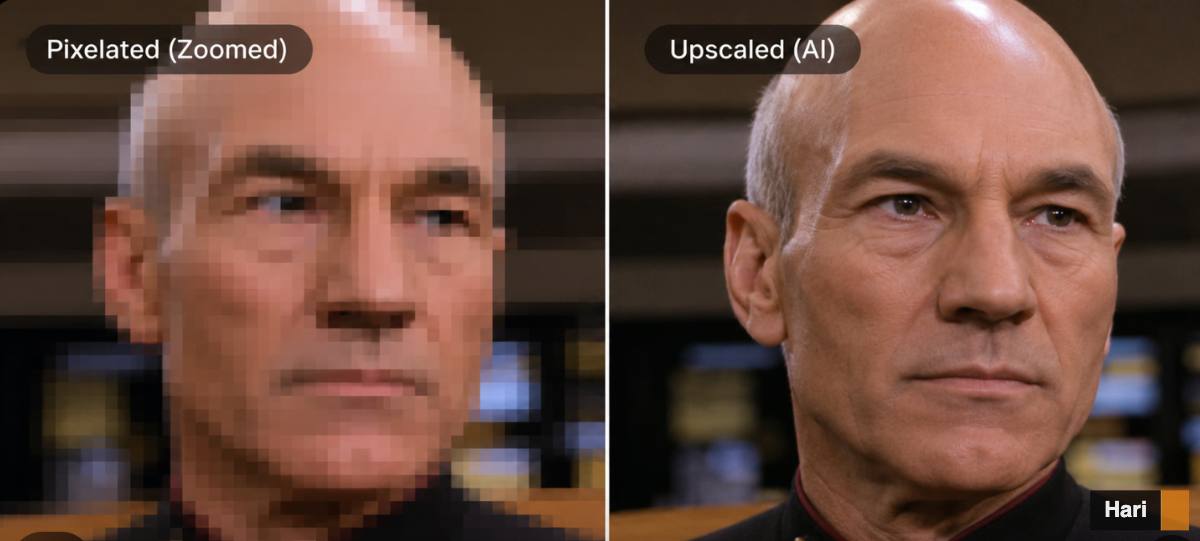
AI upscaling tries to solve this by predicting what the missing details might look like but the end result? Closer to 90% but not 100% original, because it involves prediction.
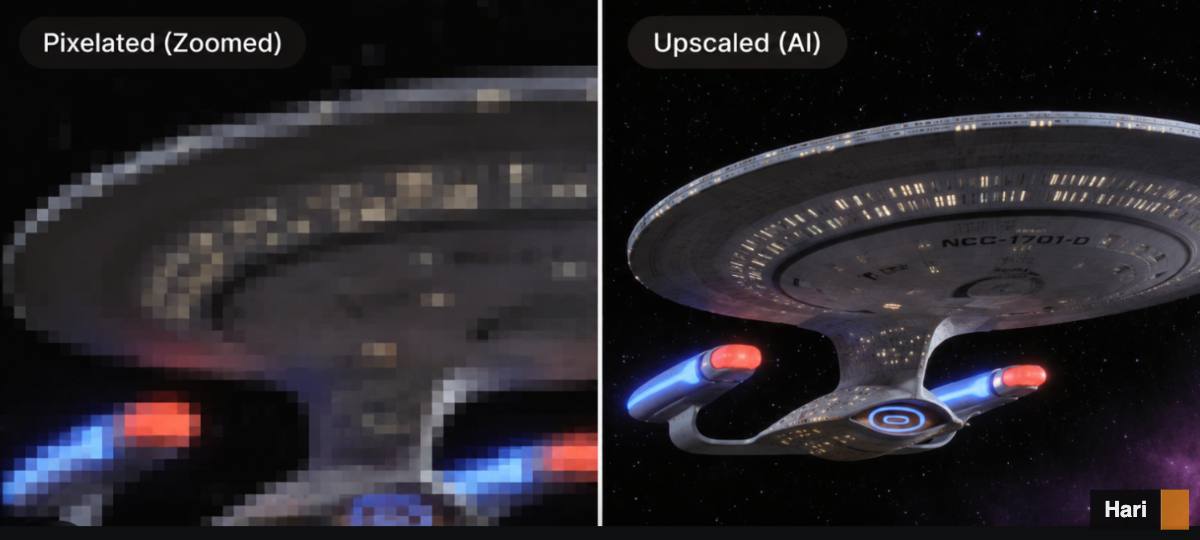
Pretty impressive at this stage and eventually they would get better to mimic 99.9% or more than we can live with, but it made me wonder:
- Are we going to keep generating more pixels every time we need a sharper image?
- Will the size of images and videos always going to increase with time?
There is no doubt screens and display technologies evolve with time. But, there is less advancement in the core problem. That's when I started looking more closely at vectors at Adaver.
Unlike regular images, vectors use mathematical shapes, curves, and colors. Instead of predicting additional pixels, a device can calculate how those shapes should look at different sizes.

Of course, there's a catch. A photograph has millions of subtle details, shadows, textures, and gradients. Turning all of that into mathematical shapes without losing the original appearance is incredibly difficult. AI these days predicts and write an svg for such blurred images, but its incredibly difficult to retain shapes when zoomed
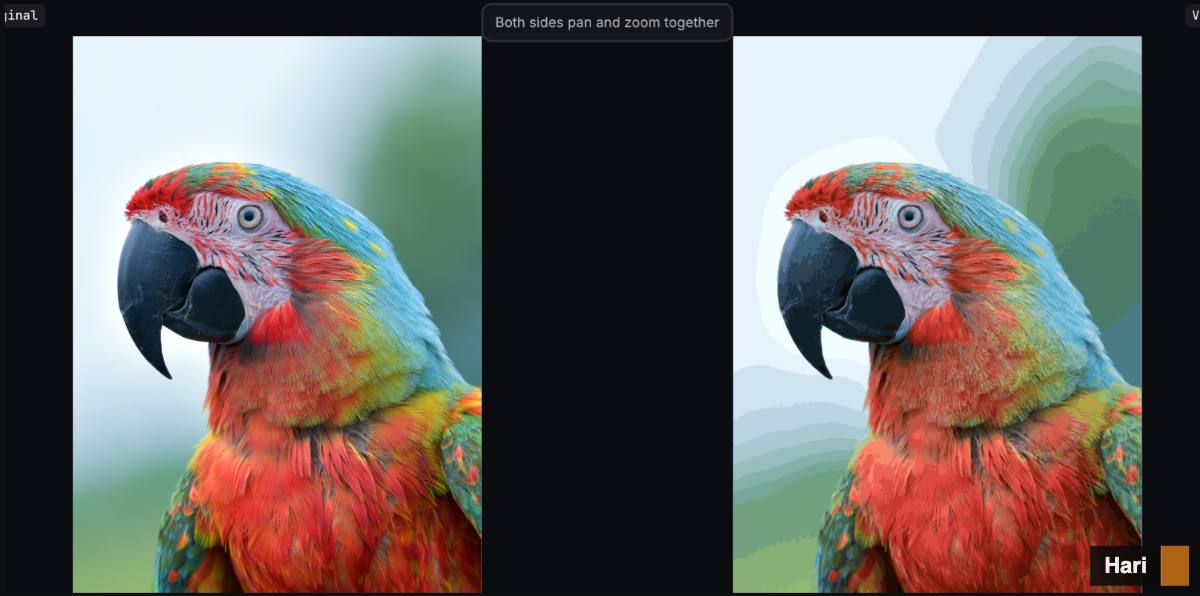
And that's where the research at Adaver has taken over the last few months. There is an experiment silently by a group with different approaches to build a standalone tracing engine better than vtracer, without depending on generative AI.
Still there is a lot to explore on that side, lots to figure things out, but the idea of a future where images aren't limited by their original resolution is something that I find it really interesting.
Not everything needs an API call or an AI model predicting the next detail. Sometimes, we can just compute things mathematically using the same AI :)
Curious, could vectors eventually become a practical alternative to pixels for photographs?
PS: Ironically, I was trying to post this and I hit myself with vercel's hard coded 4.5MB max limit and I had to figure a way to workaround :) We def need an alternate future.
Discussion